As a caregiver, it’s easy to feel like I’m saying the same thing over and over. “Do this. Don’t do that. Time to get ready…”
Over time, constant verbal prompting can create prompt dependence, the expectation that another person will always tell you what to do next. The environment has taught the person to wait for instructions. It’s important to recognize this isn’t laziness or defiance because prompt dependence is something we can reduce.
Prompting isn’t the same as support.
Support helps someone complete a task. Sometimes support means doing part of the task together or providing physical assistance.
Prompting is a cue intended to help someone complete a task more independently.
Prompting can include: verbal reminders, gestures, pointing, physical prompts, picture schedules, written checklists, timers, or electronic reminders. The goal of prompting should always enable the person to rely less on another person over time.
Prompting is about expectations. Support is about needs. A person may always need support. But, they shouldn’t always need another person telling them every step.
Ask why prompts are needed
- Are the expectations clear?
- Can they see the steps required to complete the task?
- Is there a skill they’re missing?
- Have they learned that they should wait to be told what to do?
- Is anxiety making it hard to get started?
Often the answer is to make the task more explicit.
Put information into the environment
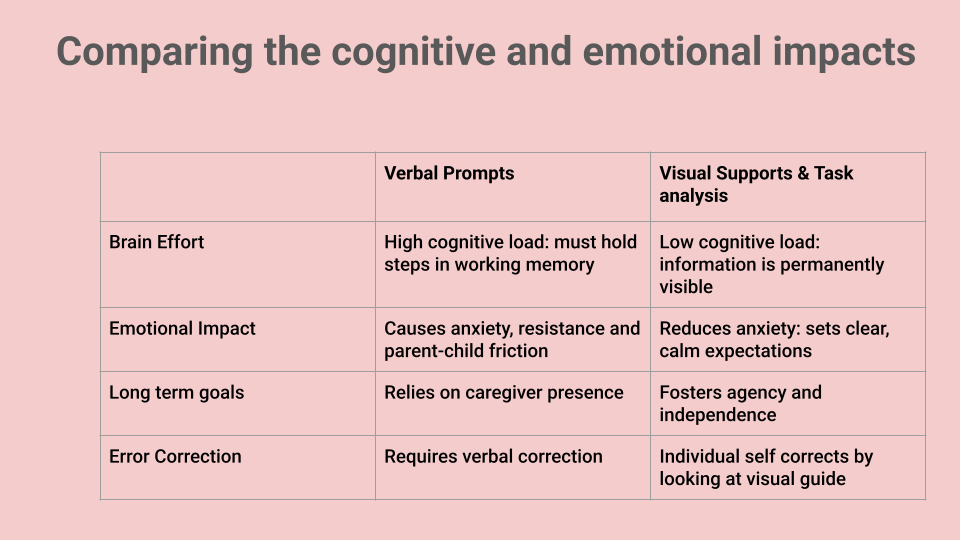
Instead of reminding someone how to wash their hands everyday, create a visual sequence.
Instead of explaining a morning routine every morning create a checklist.
When the instructions stay visible, the person doesn’t have to remember every step, or wait for someone else to remind them.
Five thousand prompts a year
Imagine someone needs reminders to complete three daily tasks. Each task takes about five verbal prompts.
That’s:
3 tasks x 5 prompts x 365 days = 5,475 verbal prompts every year.
One person has to hear directions for a simple task five thousand times. No wonder everyone feels frustrated.
Every repeated prompt is an opportunity to ask:
Could this become a checklist? A picture? A timer? A calendar reminder? A label? A visual schedule?
Body doubling isn’t the same thing.
Many people, especially autistic people and people with ADHD, find it easier to complete tasks when another person is simply present. This is often called body doubling. The other person is providing a sense of structure, accountability or regulation.
Body doubling can be an effective accommodation. Pay attention to whether your presence is providing emotional regulation or whether it has become another prompt the person depends on.
The important thing is to be intentional.
Prompt less. Teach more.
Make instructions easy to access without another person’s input.
- Keep language short and concrete.
- Match your language to the person’s communication level.
- Give processing time before repeating yourself.
- Use pictures, written instructions, demonstrations, and videos.
- Break complicated tasks into visible steps.
- Use timers, songs, counting, or other coping tools to support transitions.
- Assume nothing is “obvious.” Make expectations explicit.
Replace as many verbal prompts as possible with tools the person can access independently. While there may be tasks that an individual with I/DD never completes entirely independently or automatically, tools like printed schedules, written instructions, visual supports and assistive technology empower people with agency over their daily lives.
Discover more from Meet The Horizon
Subscribe to get the latest posts sent to your email.
 Meet The Horizon