At the end of fifth grade, when I picked up my daughter from school, her 1:1 paraprofessional would tell me about her day. One afternoon, before the paraprofessional could say a word, my daughter ran up to me and announced in the snarkiest voice, “I had a good day.”
The sentence and the attitude were both remarkable, considering her communication impairment. This was a message that I needed to understand. She didn’t want adults talking about her as if she weren’t standing right there.
This helped me realize I needed to start changing how I showed up as a parent.
Developmental psychologists have described parenting as a series of stages. As children grow, parents are expected to adapt their roles, from nurturing and setting limits to gradually sharing authority and eventually preparing for a child’s departure into independent adulthood. Parenthood itself is a developmental process where parents undergo an ongoing redefinition of who they are in relation to their child or children.
As the parent of a daughter with intellectual disability and autism, some of the milestones associated with the “Departure stage” may never occur in the typical sense. But there are still stages. Parenting doesn’t stay frozen in time, even when it feels that way.
My daughter is a young adult, she has her own expectations and opinions. In her own way, she sees herself as in charge of her life, and her father and I are the obstacles.
While I never set out to be a Super Parent, over the years I’ve had to be the advocate, teacher, scheduler, project manager, crisis manager and more all at the same time. As we get older, the Super Parent model isn’t serving me, or my family as well. I’m trying to make the mental shift from being the person who does everything to being the CEO of my daughter’s life, in collaboration with her.
A CEO coordinates plans, builds systems and makes sure the right supports are in place. And when the workday is over, a CEO gets to go home and enjoy their family. Sustainable caregiving means allowing myself to change my role, and create the space to have a relationship with my daughter that’s more than an endless list of tasks.
I created this diagram to help understand how different disability services fit together and how they were funded. Eventually, I realized I had also mapped the work of caregiving.
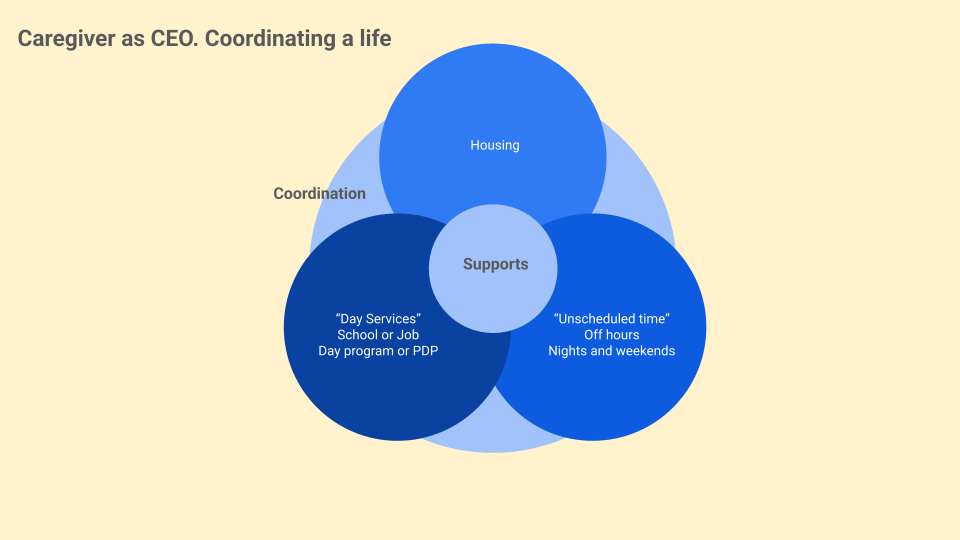
The three large circles represent the three major pieces that have to work together:
- Housing
- What happens during the day (school, employment, day supports)
- Everything that happens outside those structured hours.
Around them is the work of coordination: paperwork, advocacy, communication, transportation, planning, and crisis management.
In the center is the direct support the family provides. That center circle could be larger or smaller and it may shift over time. It can also be thought of in slices, depending on whether support is hands on or more about monitoring and readiness.
There’s no denying that the family unit is the system that supports my daughter, and it’s not always easy to make even small changes. This diagram helps me step back and visualize the work of caregiving. I can look at the pieces, identify what needs to change and imagine a future that is different, and hopefully more sustainable.
Discover more from Meet The Horizon
Subscribe to get the latest posts sent to your email.

