Infrastructure is the underlying framework for the resources that governments provide. Institutionalization means that some people, especially people with significant disabilities, have a different and limited access to housing, healthcare, education, work, and community life.
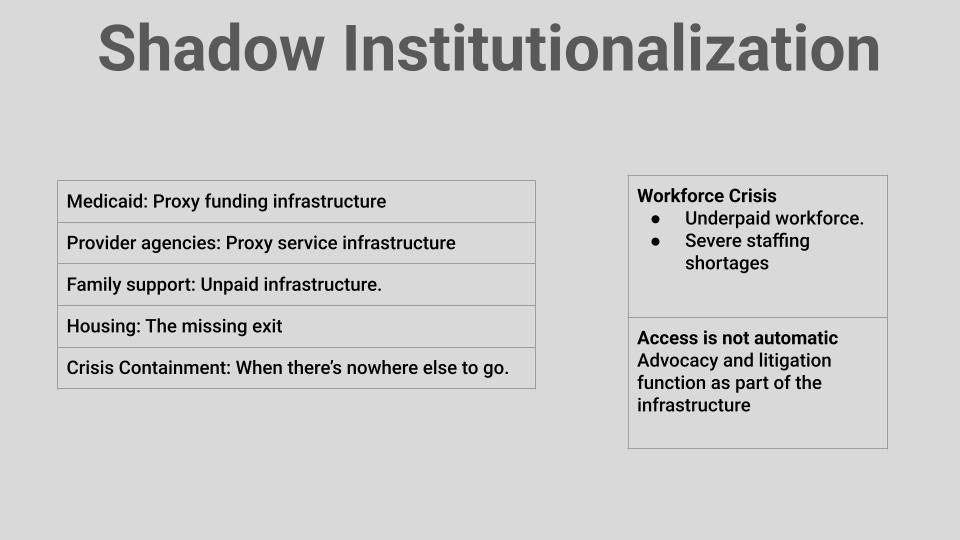
Instead of large state run institutions, institutionalization is now broken into smaller pieces. Medicaid has become proxy funding infrastructure. Provider agencies have become proxy service infrastructure. Families become the unpaid infrastructure when both fail to fulfill people’s needs. And when community infrastructure breaks down, emergency rooms and jails function as containment systems, as the only infrastructure that remains available when community infrastructure fails.
We are living with shadow institutionalization.
I recently wrote about how special education is a safety net, providing foundational instruction when it was never designed to do so.
Adult services for people with disabilities is similar. Consider Medicaid and Special Education:
- Both are “last resort” services. They often become responsible for problems that could have been prevented with earlier investments.
- Both are expected to individualize services after broader systems have failed to reach people’s needs.
- Both operate under chronic fiscal pressure while needs and demand continues to grow.
- Both create incentives that can unintentionally reinforce dependence on expensive interventions instead of prevention.
- Both are shaped by historical bias about disability that no longer matches current knowledge.
Medicaid waivers and state programs provide the mechanism for funding supports. The supports themselves are implemented by Provider Agencies. These organizations have to create and coordinate specialized versions of community infrastructure that includes people with significant disabilities.
They aren’t funded enough to sustain this. We can see the results in the workforce crisis.
Low direct support professional wages leads to staffing shortages. Families absorb the gap when there is insufficient capacity or services.
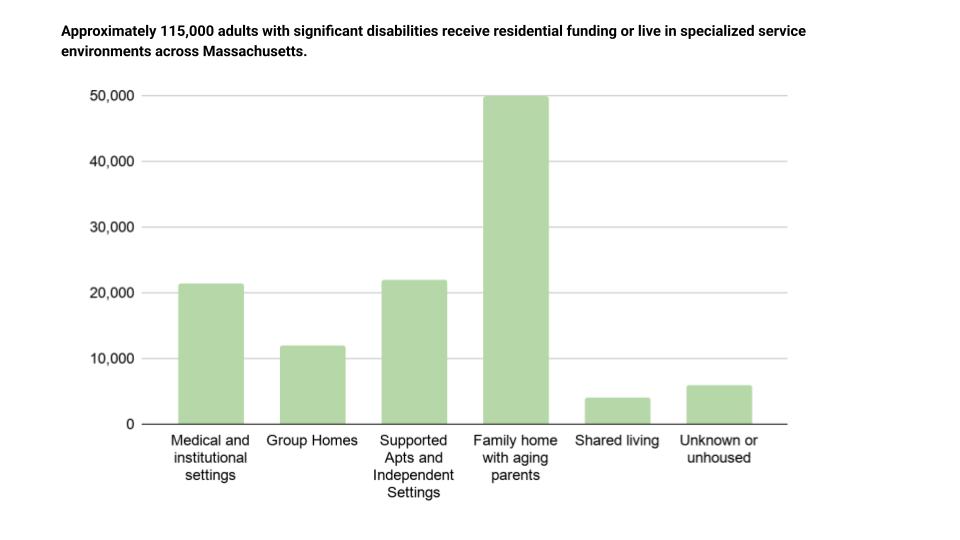
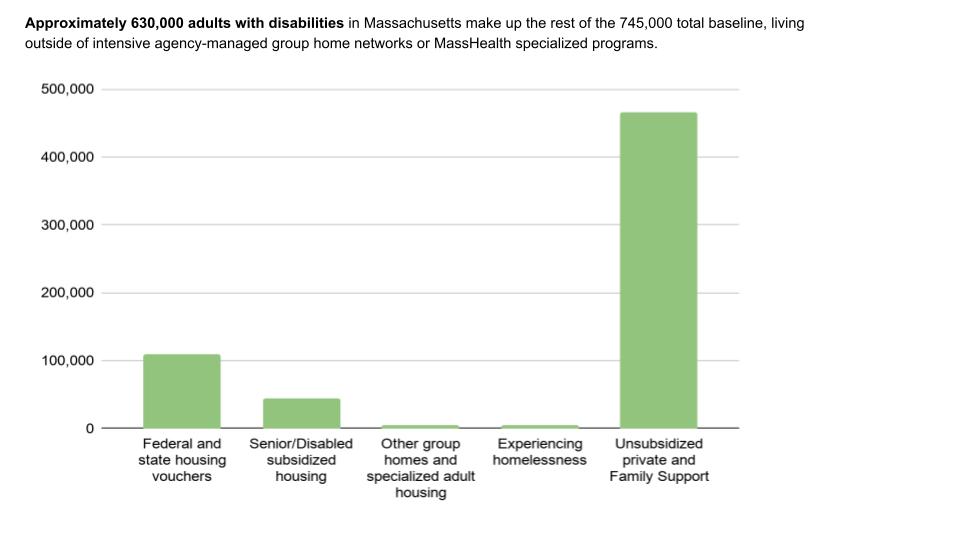
The majority of housing and supports for adults with disabilities is provided by families. As caregivers age, individuals are more likely to end up in a crisis situation. People who don’t have family caregivers lack this safety net and may go directly into crisis.
When a person is in crisis the response is different if they are perceived as a person needing support, a patient, a public nuisance or a criminal threat. Over 50% of the incarcerated population in MA are Black or Latino.
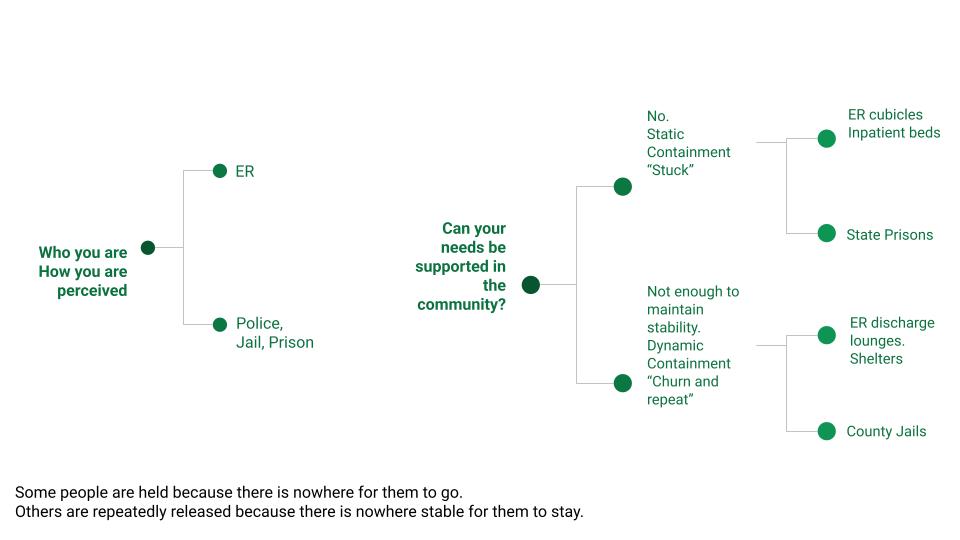
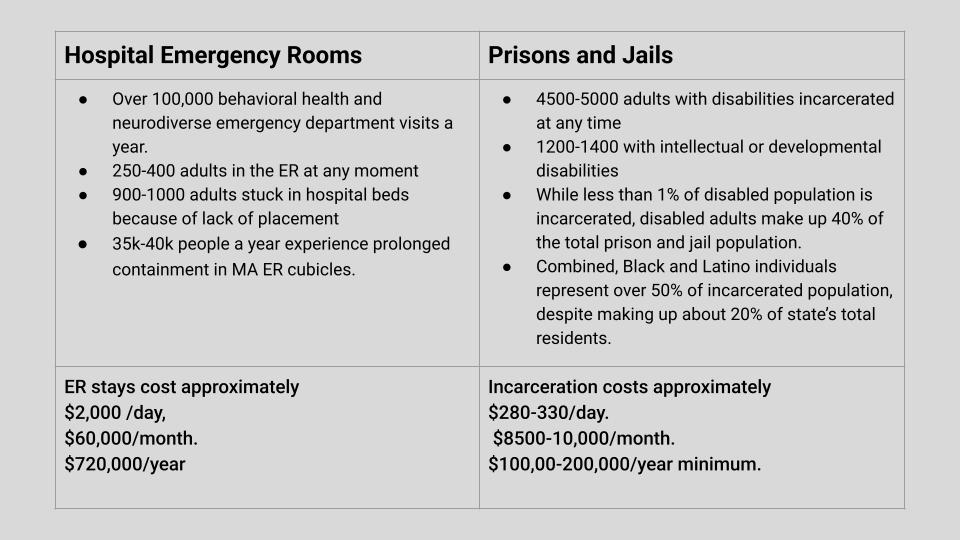
A private pay, assisted living placement or specialized residential care would cost about $10,000 a month, about the same price as incarceration. Every 30 days that an adult with disabilities spends in a hospital hallway because there are no community slots open, the state is spending $60,000. That means the costs to the state are six times higher than a private placement, to keep individuals stranded in the worst possible medical environment. Six individuals could be served for the price of one.
Hidden costs of compliance and enforcement.
Significant lobbying and litigation is required to obtain services and supports including housing. This is money that could go directly towards services.
MA was ordered to pay $1.8 million, just for the plaintiffs’ attorney fees in Marsters v Healey. If that money had instead gone directly to the Home Modification Loan Program (HMLP) which gives families up to $50,000 to make homes wheelchair accessible, 36 adults with severe disability could have transitioned out of institutional nursing homes and back into their communities. The state’s legal expenses were certainly higher than $1.8 million. Taxpayer dollars are spent to prevent taxpayers from getting services.
Organizations like the Arc of Massachusetts and the Disability Policy Consortium spend millions advocating both to prevent cuts to existing services and to obtain lacking services.
Workforce crisis
MA disability provider agencies face a severe staffing crisis. Direct care workers are paid near poverty wages. Mandate a $25/hour minimum wage for direct support professionals. A fraction of the money spent on legal battles, lobbying and boarding in ERs would fund this.
The math is clear, yet our policies seem built to ignore these facts. Selecting containment over community investment, is the definition of shadow institutionalization, an invisible, expensive machine that runs on crisis rather than care.
Discover more from Meet The Horizon
Subscribe to get the latest posts sent to your email.

