My last post, Shadow Institutionalization, showed that the system of crisis containment is costly and leaves individuals lacking in options. The majority of people with significant intellectual and developmental disabilities live at home with family, or with family-provided supports.
Most families aren’t told about a missing piece in community care.
ICF/IID stands for Intermediate Care Facility for Individuals with intellectual disability. Intermediate refers to a population of people who need 24 hour residential care and active treatment that is more comprehensive than ordinary residential services. It’s important to point out that this is not another name for an institution. The history helps show the intentions and the gaps in our current services.
At the peak of institutionalization, in 1967, individuals with intellectual and developmental disabilities were confined to state and county run institutions. These facilities were overcrowded, understaffed and residents were subjected to neglect and abuse. There were few federal quality of care standards.
States paid for the costs of institutional care, until 1971, when the federal government created the “Intermediate Care Facilities for the Mentally Retarded” (ICF/MR) program. This marks the first time federal Medicaid funding was tied to quality of care standards for this population.
ICF/MR facilities had to provide health and rehabilitative services, professional oversight and active treatment. There had to be ongoing individualized programs including medical services. This allowed states to receive federal matching funds if their facilities met strict standards for staffing, safety and 24 hour care.
During the following decades, the institutional population declined, ICF/MR services were provided in smaller facilities and more people were supported in the community. These changes were possible because in 1981, Congress created another pathway.
Section 1915(c) of the Social Security Act authorized states to waive certain Medicaid requirements so they could provide Home and Community-Based Services (HCBS) to people who would otherwise require an institutional level of care.
This allows states to use Medicaid funds to support individuals in their own homes or community settings. States can use the authority granted by the waiver to target specific populations, limit enrollment and establish other restrictions.
ICF/IID level of care is still an actual need. HCBS is an alternative way to support people in the community.
A waiver is a waiver of Medicaid rules.
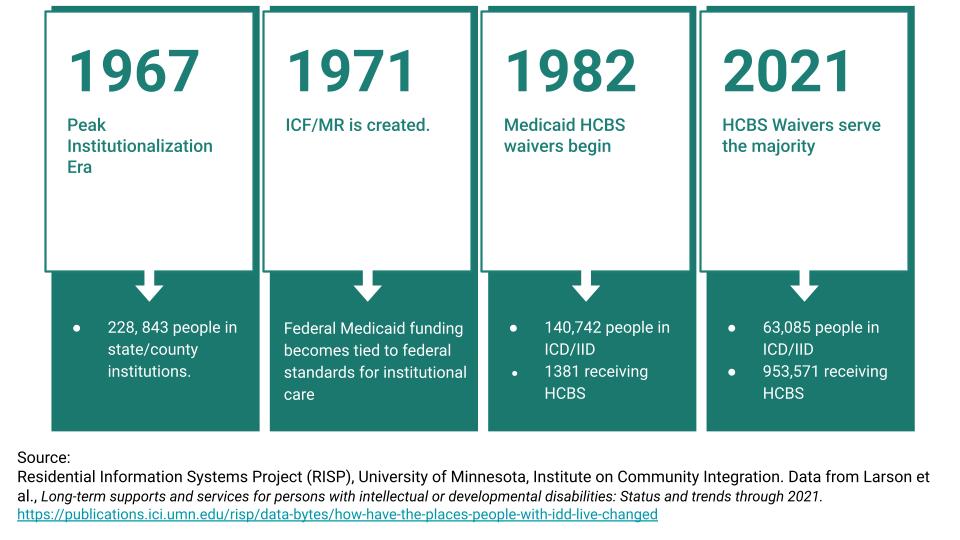
Hundreds of thousands of people are living in homes and communities. This is a success to celebrate. At the same time, I wonder, did we move the people, or did we move the care?
What is ICF/IID care?
ICF/IID is a Medicaid benefit for people with intellectual disabilities who need and receive active treatment. Services are individualized, and can include:
- Medical services
- Nursing
- Therapies
- Psychological services
- Habilitation and training
- Behavioral support
- Community integration
- Individualized planning
- 24-hour residential support
- Federal standards and oversight
ICF/IID is a care model, that has comprehensive standards lacking in the institutionalization model of the 1960s. The quality standards are quite contemporary. The federal program recognizes that the size and location of a facility can change, while the level of care remains. Even though the word facility is in the name, the standards can apply to a variety of settings.
We haven’t built enough places capable of providing the level of care some people actually need in the community.
Families are mostly presented with community based options like group homes or HCBS waivers. The real question is, what does a person need, and how can that level of care be provided in a place where they can live an ordinary community life?
What would it look like?
Imagine a residential community designed for people with significant disabilities. People have their own apartments or homes. Staffing can increase with people’s needs. They have access to medical and nursing support. Therapists and behavioral professionals are part of the infrastructure, rather than emergency resources.
There are common spaces, gardens, transportation, employment and community activities. People with different levels of disability can live in the same broader community.
Saving Wrentham and Hogan Alliance presents an ideal model for the redevelopment of these campuses to include elderly and other housing.
Most individuals will be directed towards community based waivers, and aren’t told that ICF/IID is an option. Families may need to ask specifically how an individual’s level of care and support needs are being assessed. Assessment tools used by DDS include, MASSCAP, ICAP and Consumer Caregiver Assessment. Families may need to formally request these assessments in writing.
We can do better. People with significant disabilities should have control and choices in their lives. The best part of the ICF/IID level of care framework can be built into the community.
Further information:
The Arc of Mass has good information about DDS assessments and priority levels:
Saving Wrentham and Hogan Alliance has a good explanation about how
ISP=Person centered plan. POC = service grid.:
And about Understanding Care denials:
Discover more from Meet The Horizon
Subscribe to get the latest posts sent to your email.

